Introduction
It excites me that a group of guys from the Netherlands can shake up the entire keyboard industry. Keyboards have been around since the dawn of computers, how can someone entering the market in 2015 innovate, and establish themselves as the key driving force in the industry?
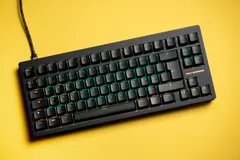
After using both the 80HE and the 60HE v2 with split spa|ce|bar (both in ISO mind you, I love me some fat Enters), what strikes me is the pure dedication to detail and performance. Best in class performance and adhering to your community. Add in details like the stick figure character, the flight strap, the text and instructions on the PCB and you have a solid product in your hands.
This is not the easy nor the cheap way of doing it, but it is the way Wooting does it. Playful and humorous, but at the same time dead serious on making the best out there.
I got Wooting’s CEO Calder Limmen to talk about what comes next, how the company builds keyboards from scratch, why they can’t stay ahead of the competition, and whether 8000 Hz polling actually matters.
His answers are refreshingly honest.
This interview is not sponsored. Wooting provided two keyboards for review purposes. All content is independently produced.
What comes next?
How does one of the market leaders continue to improve?
This question opens up multiple doors of opinions for me. I’m going to focus on what are things we can improve on top of the existing keyboard lineup.
From an experience and quality of life standpoint, every Wooting keyboard already has the computing capacity that allows us to continue experimenting with new software features that they can enjoy for a long time without needing to purchase a new Wooting keyboard. We are continuously pushing out new firmware and Wootility releases that further push the performance, provide improved quality of life features, and entire new features.
From a hardware standpoint, nearly all existing and upcoming Wooting keyboards will be able to make use of our small and large knob. Simply take out the switch(es) and pop in the knob, now you have a fully functioning rotary knob.
From a keyboard experience standpoint, there is still room for improvement in the keyboard sound and feel experience. There are some fundamental problems I would like to solve, like stabilisers that are unreliable in their noise performance and rely too heavily on lube. And experimental problems, such as how we build the total keyboard and how this influences sound. We notice that we can’t simply apply every “trick” using the same material on every keyboard model, and every keyboard model requires its own tuning. It’s growing to an art, I want to pursue that art.
And finally from a quality standpoint. We experiment a lot with manufacturing processes, materials, and in the process, how we perform quality assurance in order to elevate our quality. We are looking at how we can make meaningful improvements. We are trying to raise the bar with every new product — we implemented a lot of the learnings in the 60HE v2, both in the aluminium and plastic model.
From a performance standpoint, there is little more to gain that is going to be anywhere near noticeable, as we have entered the sub 1ms space, and improvements are numbers on a chart that are splitting hairs.
The 8000 Hz question
Every keyboard brand is slapping 8000 Hz on the spec sheet. I have been openly sceptical about whether this matters for keyboards (and mice), and I wanted to hear Calder’s take on this specific question.
You will not experience any noticeable difference between 1000 Hz and 8000 Hz polling rate.
I do believe that professional or highly competitive players can notice more subtle differences than people might give them credit for, and I would advocate for that small minority that saving several milliseconds can make a slight difference. But this would be pointless for the vast majority.
Unlike a mouse, the keyboard doesn’t continuously update new coordinates. It simply updates an on and off state. There is visually nothing to observe. You can’t press fast enough to get anywhere close to one millisecond, let alone 0.125 milliseconds.
In contrast, what Rapid Trigger and Adjustable Actuation Point did was eliminate tens of milliseconds of travel time, and hundreds of milliseconds for subsequent presses. It’s as clear as day and night for a majority of people, especially with subsequent presses.
When it comes to the difference between 1000 Hz and 8000 Hz, I honestly can’t advocate for it, even for the small minority. We’re talking sub-milliseconds — you can’t comprehend how incredibly insignificant this is.
How Wooting builds a keyboard
Many keyboard brands outsource everything to an OEM and put their logo on it.
Wooting does it differently, and the production time from concept to market is longer than you might expect.
The entire process of developing a product before it can go into Mass Production (MP) is called New Product Introduction (NPI). This can entail slightly different wording and steps for different companies, but for us it’s divided into the following milestones:
- Concept & Feasibility: 3–6 months
- Engineering Validation Test: 3–4 months
- Design Validation Test: 4–5 months
- Production Validation Test: 2–3 months
Roughly 12 to 18 months of development depending on the complexity of the product. You should imagine that through every phase something gets in the way that needs to be solved. We often also are willing to jeopardise an entire product development timeline if it’s in the benefit of the product. Lose two months, but make the product 20% better? Okay!
Concept and feasibility can also take longer — it takes time for an idea to mature, but it also depends on how many other projects we have running. Not to forget that post-sale, there is also a lot to follow up on existing products. You just delivered thousands of products that are used in thousands of new ways in thousands of new environments. No matter how much you test, something is bound to not go well.
We do a lot of the processes in-house. We have our own industrial designer, mechanical engineer, electrical engineer, software engineer, graphics designer, packaging engineer, and quality assurance. It’s important to me that we own all the IP of our core business, and build up as much knowledge as possible. This is also why we’re not embarking or quickly jumping into other product categories, and how we’re able to deliver a unique product. Unlike other gaming brands that lean on all the resources provided by the manufacturer with very little to no in-house knowledge, we are more development than business orientated.
We partner with OEM manufacturers that have the facilities, equipment, and sub-contractors to manufacture our product at scale. You can see glimpses of how we manufacture the 80HE, 60HE v2, and even the Wooting one if you go back far enough on our YouTube channel.
How does Wooting stay ahead?
This was maybe the most crucial question. Wooting pioneered hall effect and analog input in gaming keyboards.
Now every brand is doing it, so — now what? What comes next?
Honestly, we can’t.
We achieved what we set out to do with our keyboards and got an entire industry to move in the same direction. This was five years building up to the moment and five years of the industry shifting.
We’ve graciously used that time to create a company in our own vision and a stable business model that doesn’t rely on any external funding. This provides us now a unique opportunity to continue building products that pique the most interest and excitement, without investor pressure and short-term profit-driven decision making.
After all, a lot is luck — we just need to create ample opportunities for luck to take place. And the greater the opportunity, the greater the risk. It applies to everything.
I feel confident that if we retain our company culture and spirit behind product development while focusing on incremental improvement, then we’re bound to stumble into the next thing.
Community and the split spacebar
The community is great at providing new insights but not so great to rely on for vision.
Vision works best when you have someone confident, but not stubborn, that can distinguish the difference between an innovation and a solution. You can’t get that from a community as a whole. You can however question why someone makes a suggestion and figure out what they’re trying to solve with it. This provides a unique insight that can help build the vision.
Community also helps gauge urgency for a certain development and provides positive or negative feedback that can be used for future development.
We introduced it with the 60HE v2 as an experiment. The confidence to run the experiment came from hearing suggestions from the community, but how well it could or would be utilised by a majority was hard to gauge. Now that we’ve introduced it and gauged feedback, we can see that people are catching on and we can expand on it.
If I take one of the latest examples — the split spacebar.
Editorial note
What I take away from this conversation is that Wooting is not chasing the next spec war.
Wooting are chasing craft, a solid company culture, stabilisers, sound tuning, knobs and software features pushed to owners of existing keyboards.
I think we all are going to be chasing the elusive “knob-feel” soon.
The mindset is aligned with a solid product studio, and I think that is exactly why they ended up challenging the industry in the first place.
A huge thanks to Calder Limmen and Wooting for taking their time to answer my questions.