
You are worse in one direction
The problem is that the sensor in your mouse tracks with the same sensitivity and resolution in every direction, while in reality our hands, muscles and brains don’t move like that.
We humans don’t have the same sens, or the same movement pattern, across all 360 degrees. The vast majority of us are more accurate in one particular direction and less accurate in another.
Maybe you’ve noticed it yourself, that you hit better when you move your hand from right to left? I certainly have.
Corsair and Aimlabs now want to fix this. They have measured this across millions of players, and their answer is PureVector. The mouse learns where you miss, and corrects for it using a vector based smoothing sense curve applied to your Sabre V3.
To me it is the biggest new feature of Corsair’s new Sabre v3 Pro, and it’s what this article is all about. The Sabre V3 launch itself, I’ve covered in a separate article.

I attended Corsair’s Sabre v3 press briefing (or rather, I watched the briefing in replay), and Corsair has sent me a test unit of the Sabre v3 that I barely had time to test before this embargo lifts. Review incoming, stay tuned dear reader.
One sensitivity doesn’t rule them all
Think about what sensitivity in mice actually is. You set 1200 DPI and 0.75 sens in game, and the same ratio between mousepad and screen applies across all 360 degrees. Whether you flick right, left, up or down.
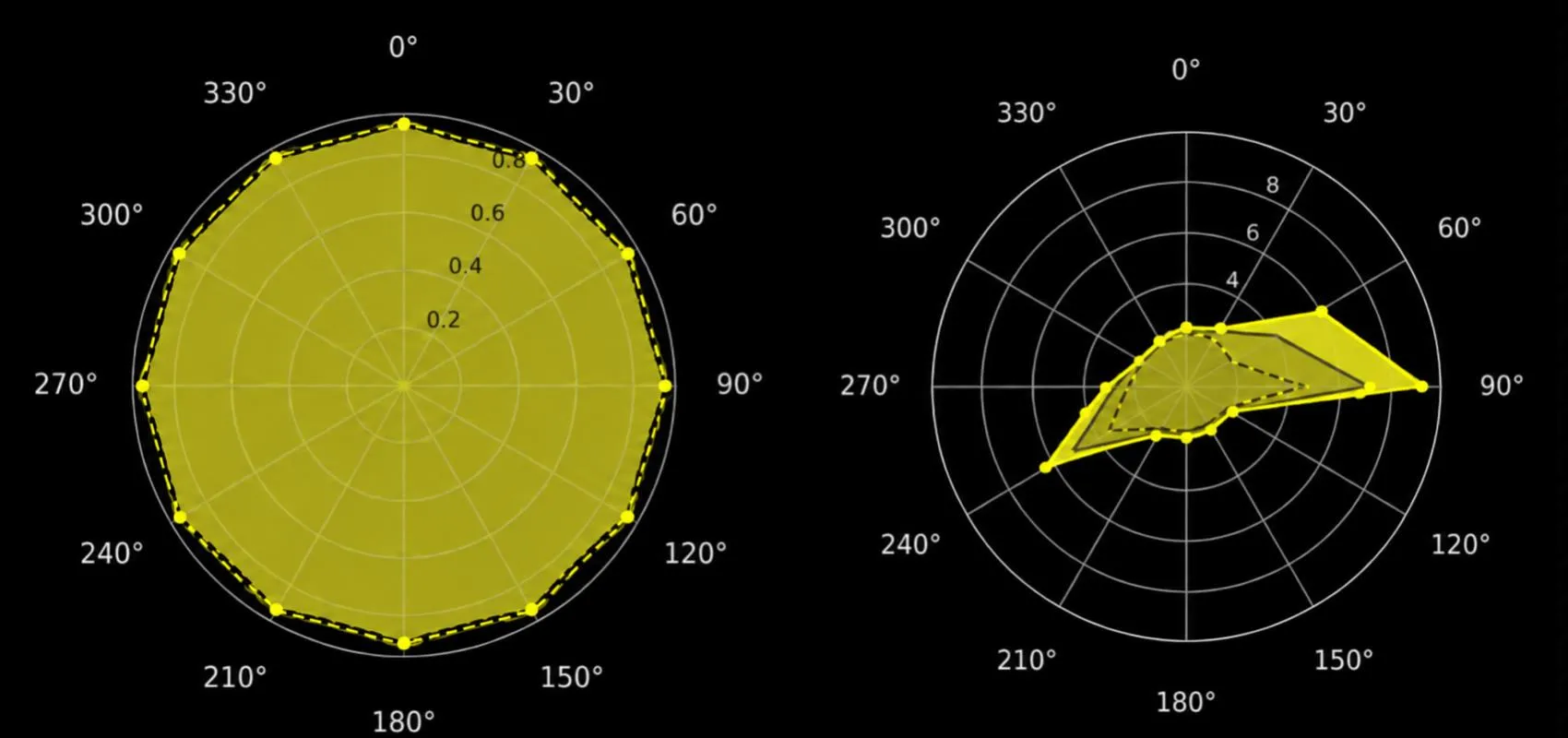 Left: what a single sensitivity value assumes. Right: what a player’s aim movements look like in Aimlabs’ data. / Credit: Corsair
But moving the mouse away from your body, towards your body and across your body are all different movements, biomechanically speaking. Aimlabs’ data shows that the same player can stop neatly on target in one direction, and overshoot and have to pull back in the opposite direction.
Testing this with myself yesterday, I can verify. I tend to overshoot.
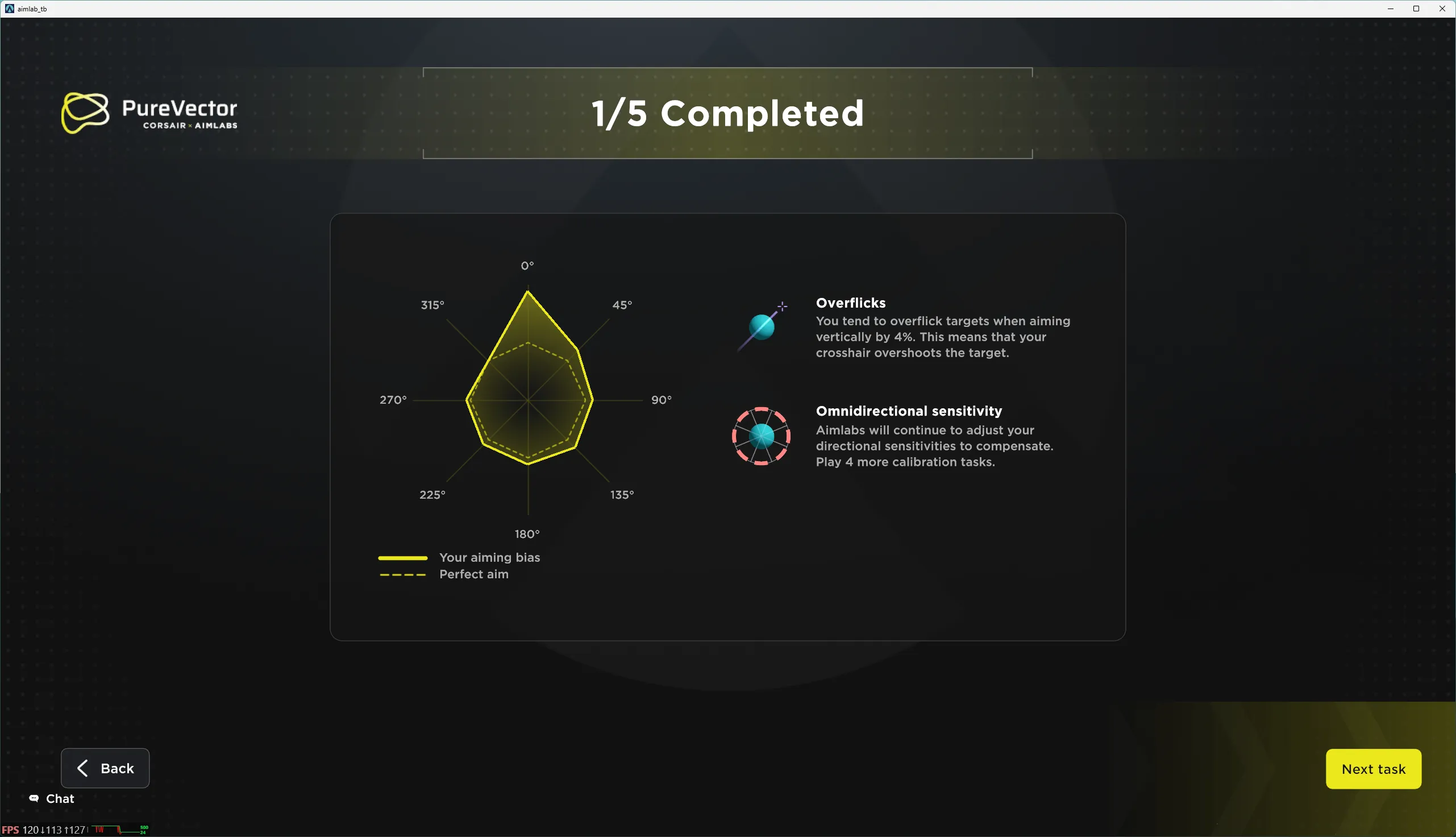 I overshoot, as the first round in Aimlabs proved. / Credit: kaytomas.com
Another interesting part is that this bias is stable for each individual, even pros according to Corsair and Aimlabs. It holds over hours, days and weeks. The point is that this weakness differs from player to player, and this is exactly why copying pro players’ settings doesn’t make you a better player. They have their bias and their weaknesses, and so do you.
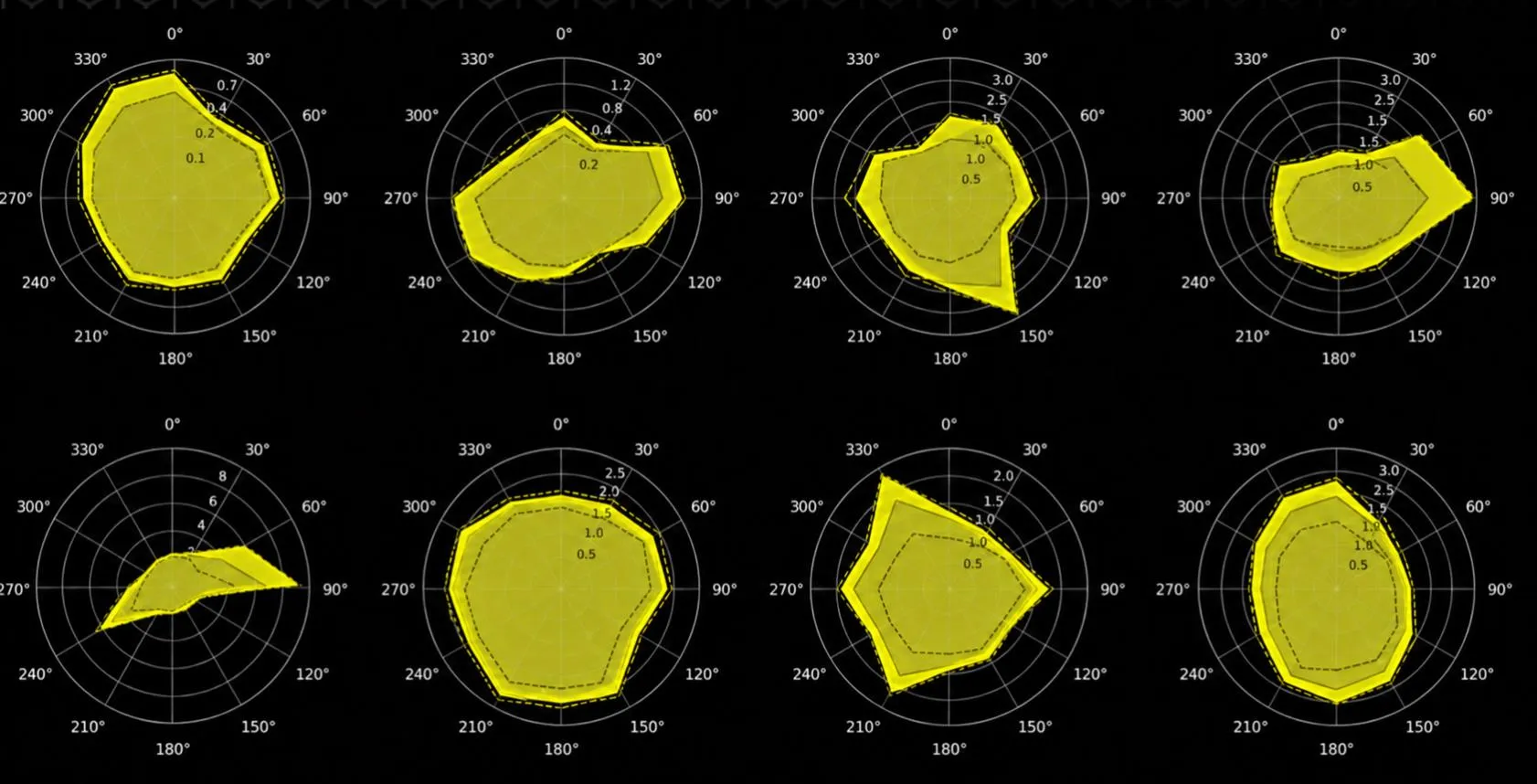 Eight players, eight different shapes. The bias is consistent for each individual, but differs between them. / Credit: Corsair
Optimizing one value for all of these movements makes no sense, says Corsair.
So what is PureVector?
Corsair calls it personal directional sensitivity. Instead of one value, the mouse gets a sensitivity curve, calibrated in every direction and tuned to you specifically.
PureVector simply corrects for your weak movement, via Aimlabs, and flashes those settings to the mouse firmware. Picture a vector curve that smooths out your weaknesses. The idea is that you get better at aiming in every direction. After a minimum of 5 minutes in Aimlabs, this vector is stored directly on the mouse, so it becomes an extension of yourself. If you already have used Aimlabs, and have saved your history there you might even get a better result.
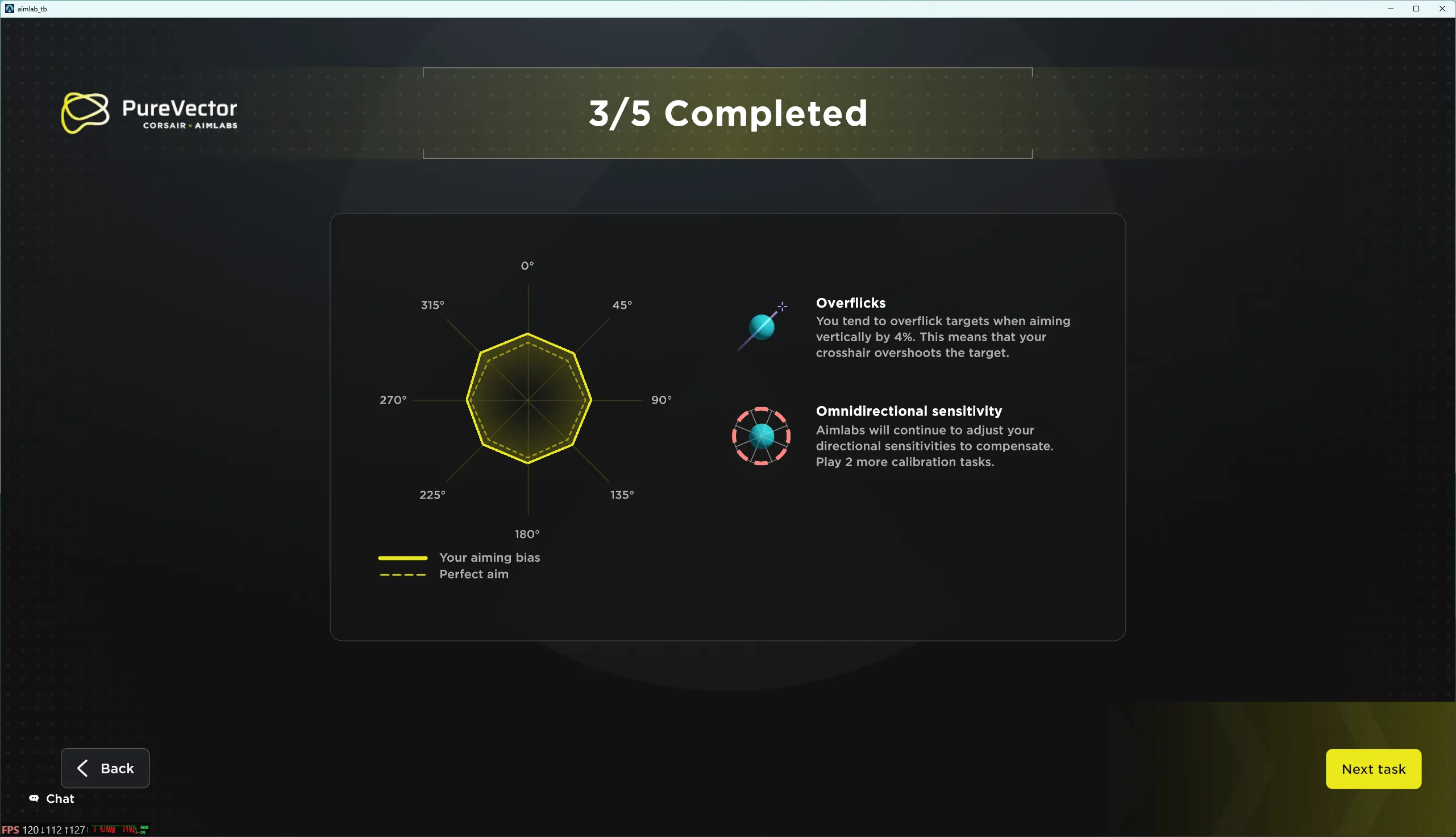 My calibration in Aimlabs, 3/5 rounds completed, with a polar chart showing my directional bias so far. / Credit: kaytomas.com
This is a collaboration between Corsair and Aimlabs, with patented technology. Exclusive to Corsair for now, but my guess is the competition will follow and that we will see this tech copied and replicated down the line.
How to enable PureVector
To enable the PureVector you visit Corsair Web Hub, choose DPI and trigger Aimlabs from there. At least that was how it was done before the Sabre v3 Pro was released.
I expect that eventually you’ll be able to trigger these settings from Aimlabs itself.
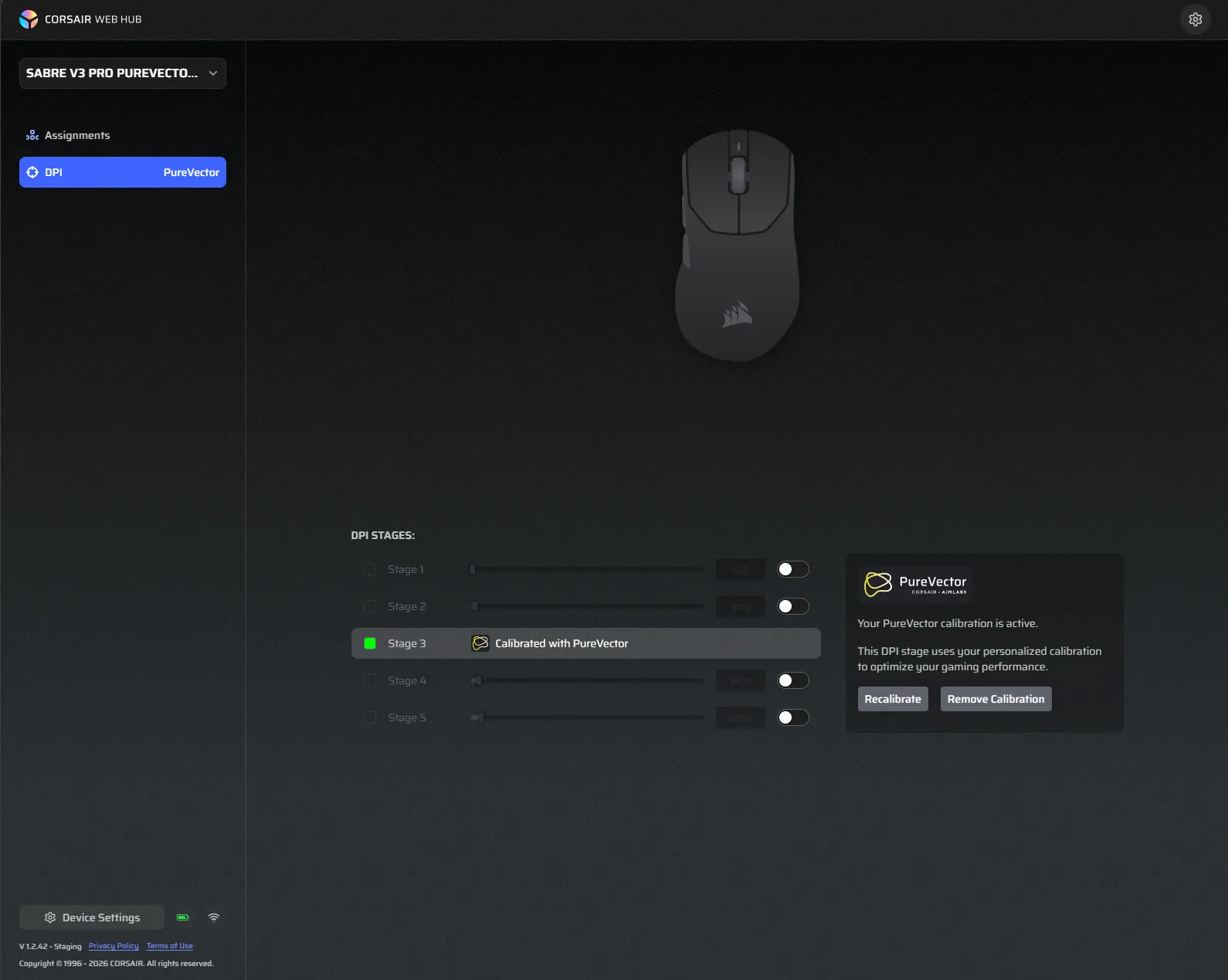 Where to enable PureVector in Corsair Web Hub. / Credit: kaytomas.com
My first calibration
I have the mouse on my desk, and got one evening with it before the embargo lifts.
The first thing I did was go into Corsair Web Hub to update the firmware, which is always a good idea with new devices. However, I was glad to see my Sabre v3 was already on the required firmware.
Then I started the PureVector calibration from the DPI settings in Corsair Web Hub.
I ran the calibration in Aimlabs, all five rounds, and it’s pretty obvious that I’m quite bad at aiming. However I am glad to see that something was applied to the mouse, and I guess I’m off to gaming?
I move swiftly over to Arc Raiders, but at this point I am out of battery on my camera and was not able to record anything. Amateur at work here, folks! The aiming felt natural, like my shots landed, but it wasn’t anything revolutionary. More testing is needed, of course, but that’s what I had time for the night before the embargo lifts.
Something that annoys me a little is that I don’t get much further. I mean I see my bias, but I still have to keep playing in Aimlabs to see my actual improvement. I was not able to get the “after PureVector” graph to show. Do note that this was late in the night, so this might be user error.
Another thing that I am uncertain of is that during the process you have to choose whether you flick, how you hold your mouse amongst other things. I don’t think all people know this, and I’d rather that Aimlabs analyzed your patterns and mouse movements to tell you what and how you aim. I’d like more feedback between sessions and a more detailed report on what PureVector has done, and maybe even the ability to fine tune this myself.
Another issue is that I can’t quite see what my DPI is after PureVector has adjusted it. Did it land around 1200? Or 1600? My ideal DPI is a great starting point when using other mice than the Sabre v3.
I mean, it says right there, in black and white, that it works. But do I feel any different? Hard to say after so little playing. At the same time, it bugs me that I can’t dig deeper into the settings in Aimlabs, but that might require Aimlabs Pro.
Either way, a full review of the Sabre v3 PureVector is coming later.
Manufacturers have chased DPI, weight and switches. Corsair is fixing your sens
Believe it or not, mouse makers keep innovating. In the back of my mind I’ve already been wondering, what will they do next? Manufacturers have long chased DPI, the sensitivity of the sensor. They’ve chased weight, the lower the better. They’ve even introduced new switch technologies, like Logitech’s HITS system, with similar systems from Finalmouse, Keychron and others.

Corsair takes a different approach with the Sabre v3 and its PureVector tech, they want to fix our weak movements in certain directions.
The man behind Aimlabs
Corsair has partnered with Aimlabs, and the founder of Aimlabs is not just a random dude when it comes to movement tracking. The man is a bona fide scientist! Wayne E. Mackey has a PhD in cognitive neuroscience from New York University, and has researched how the brain controls movement for more than 15 years.
“Okay,” you’re probably thinking. “So why are you bragging about him?”
Well, he’s the one who started Aimlabs, an aim trainer on PC with more than 50 million players and around four billion training sessions. Just imagine, that’s an enormous dataset of how people aim and move their mouse in shooters. My guess is that this is a guy the people who develop aiming devices (read: mice and controllers) for shooters would love to work with.
And that’s exactly what Corsair has done.
What Corsair promises
It sounds fantastic on paper, but how does it work in practice?
Corsair’s headline is up to 81 milliseconds faster aiming, or 33 percent. The number was measured in the beta test, as the time from when the movement starts until the shot fires. In other words, the part of a shot that PureVector affects.
In the beta test, pro players improved their Aimlabs score by 8 percent on average. Advanced players gained 12 percent, and beginners 30 percent. Gumayusi, three-time League of Legends world champion, gained 11 percent. CS2 player Apocdud gained 7 percent.
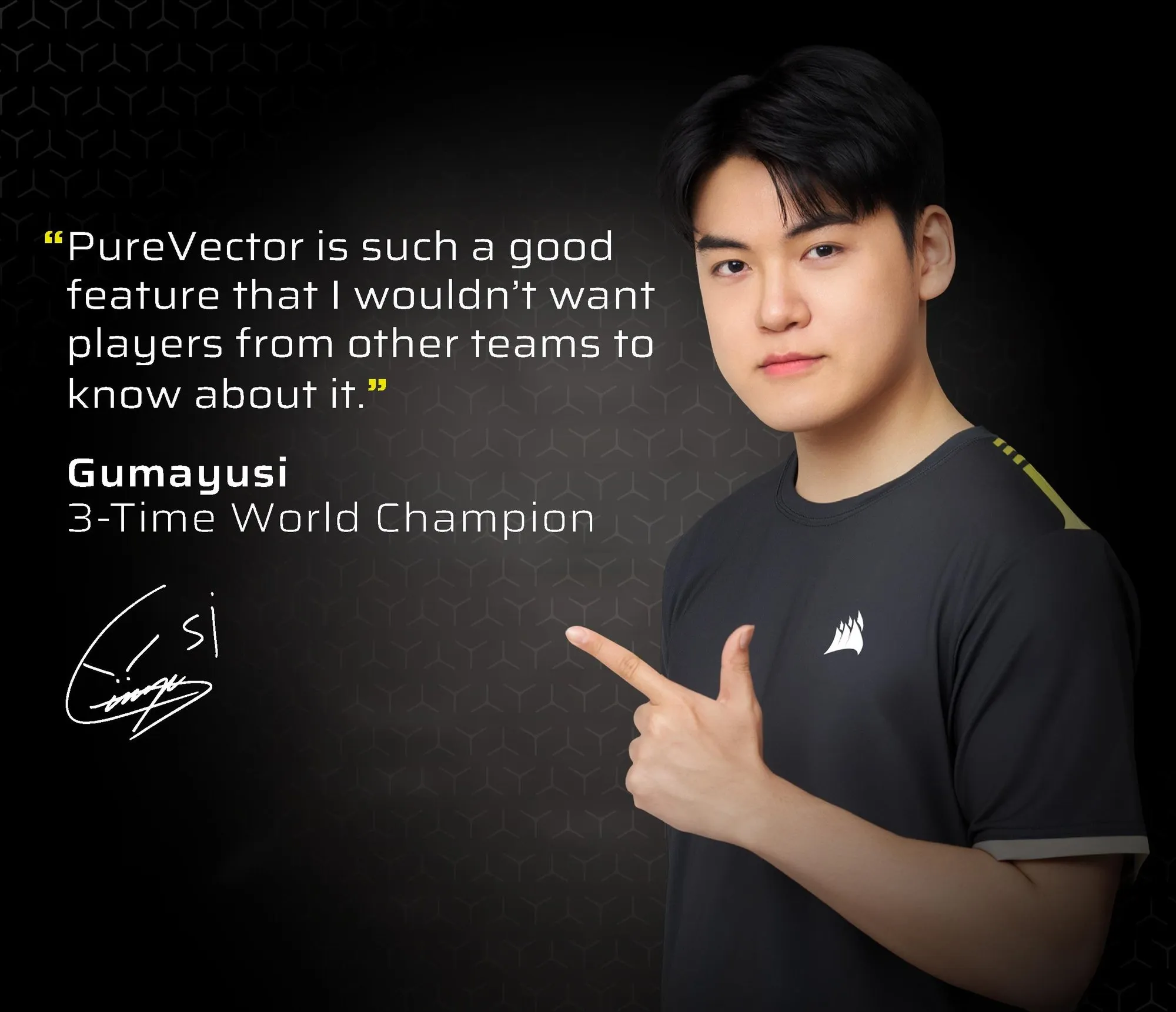 Gumayusi got an 11 percent better score in Aimlabs with PureVector. / Credit: Corsair
“The players with the most room to improve, improved the most. And even players at the top of their game improved 8% on average.” Corsair
Corsair also sets those 81 milliseconds against “a competitor” that recently promised up to 30 milliseconds faster clicks.
That competitor is Logitech, and the number is the HITS switches in the X2 Superstrike. Note that these aren’t measuring the same thing: one is aim movement, the other is click latency. Corsair’s point is that the click is the smallest part of the time from when you see a target until you shoot. Aiming, meaning movement plus correction, is the biggest. That’s where there’s more to gain. And that particular logic, Corsair, I buy.
All of these numbers are Corsair and Aimlabs’ own beta data. Nobody has tested this independently yet.
However, I’m not sure exactly how much my own aim improved. What I do know is that I was overshooting by 4-6%. I guess I will come back to this later on if I fully review the Sabre V3.
Is PureVector cheating?
Dear reader, you ask a good question! I expect a debate whether this is cheating or not. This is a mouse programmed to compensate for exactly your mistakes. Is it allowed in tournaments, then?
Corsair’s answer was no, it’s not cheating. They compare it to mouse acceleration, a setting that has existed for decades. PureVector reads nothing from the game. It doesn’t know where the enemy is. It only knows that you tend to overshoot by 9 percent when you flick right, and dampens the movement a little in that direction.
Corsair also says it’s in dialogue with esports organizers about this, but as I write these beautiful words down on my digital page, there’s no published ruling.
What about compensating for your movement bias? Something that I would think most experienced players already do? Well, what they say is that the bias sticks around even in people who have played professionally for many years. And that most people don’t have enough time to train away the weaknesses in their own personal aim.
Who this is made for
Corsair is aiming at competitive players, the ones chasing every little advantage.
The fun part is the age distribution in their numbers: more than half of the target group is over 30. In other words, people who’ve played for a long time, but don’t have time to get really good and improve their aim.
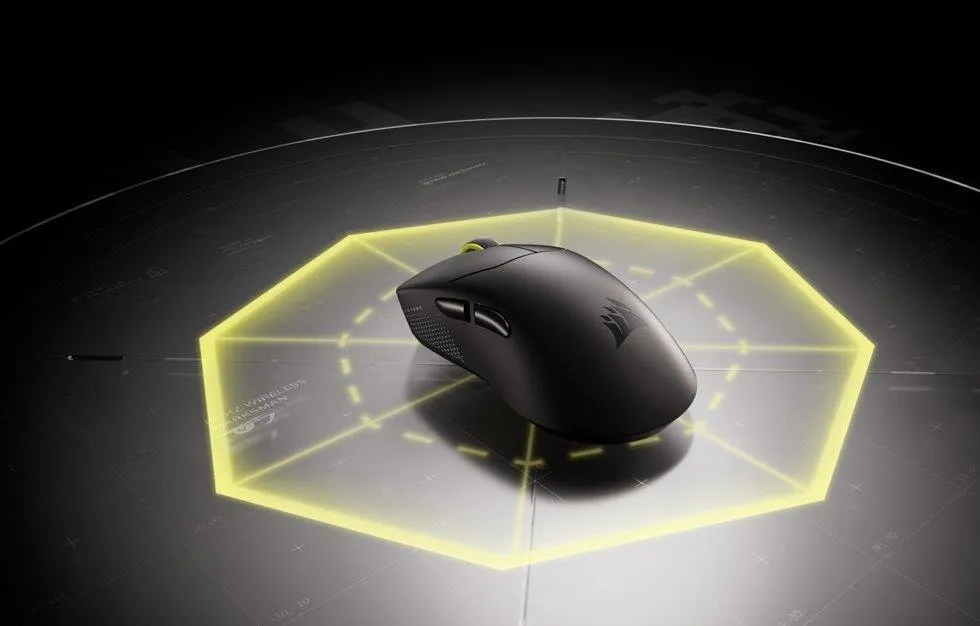 The octagon is the symbol for PureVector: sensitivity tuned to you in all eight directions. / Credit: Corsair
At the press conference, Corsair and Aimlabs call this collaboration “step 0.5”. So we can easily imagine more products along the same lines, also tuned with Aimlabs. I can at least picture mousepads and not least controllers as potential products that could benefit from the same technology down the line. Nothing has been announced yet.
For now, PureVector is only available in the Sabre v3 Pro series, six mice from $179.99. Everything about the models, specs and prices is in the launch article.
Whatever esports lands on, this is new cool innovation that marks the 2nd big one in the year of 2026. I expect the rest of the industry to follow suit. Stay tuned!
